










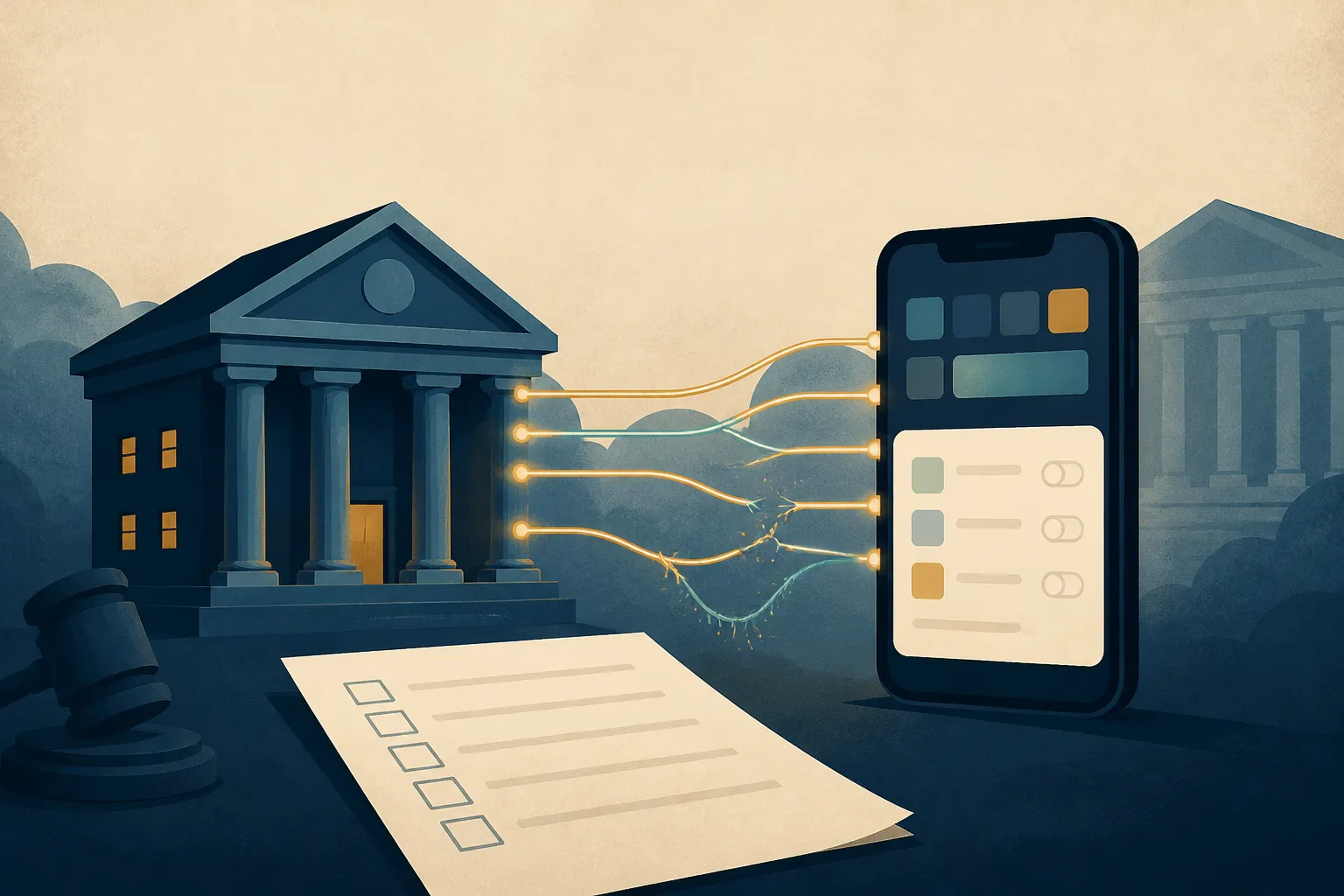
Open banking allows software applications and third-party financial services to retrieve your financial records directly from your depository institution after you give permission. While these connections power everyday tools such as digital budgeting dashboards, the legal standards that protect your account details are undergoing a major federal revision in 2026. Understanding how the rules are changing helps you track who can see your account balances and what protections remain in place.
- Clear permission: Third-party services must ask for your direct authorization before they pull account records from your financial institution.
- Defined purpose: Data collected through an authorized connection is supposed to be limited to the specific service you requested.

- Right to revoke: You should retain the ability to cut off an app's access to your depository records at any point.
- No hidden fees: Federal regulators initially barred institutions from charging consumers for access to their own transaction data, though that policy is currently under administrative review.
What Open Banking Means for Your Account
Open banking describes a digital framework where consumers instruct their banks or credit unions to share account information with independent financial applications. The data does not travel automatically. Every pipeline begins when an account holder signs up for a digital service and authorizes that tool to collect financial information from their primary institution.
In practice, data rarely travels straight from your bank to an application developer. Instead, it moves through specialized intermediaries known as data aggregators. These intermediary firms establish electronic connections, verify account information, and feed standardized transaction histories into the consumer-facing app. For example, an individual might link checking, savings, and loan records across multiple institutions into a single interface to monitor personal spending patterns. Research published by the Congressional Research Service estimated that at least 100 million consumers had authorized third parties to access their financial data by 2024, demonstrating how common these data pipelines have become across household balance sheets.
Federal privacy restrictions under the Gramm-Leach-Bliley Act generally prohibit financial institutions from releasing nonpublic personal information to non-affiliated third parties without giving consumers advance notice and an opportunity to opt out. However, customer instruction and consent serve as an explicit statutory exception. When you grant permission to an app, you trigger that exception, making the terms of consumer authorization the centerpiece of data privacy in retail banking.
The Legal Foundation: Section 1033 and the 2024 Rule
The statutory basis for open banking rests in Section 1033 of the Dodd-Frank Wall Street Reform and Consumer Protection Act, passed by Congress in 2010. Section 1033 requires covered financial entities to make available to a consumer, upon request, information in their possession concerning the consumer financial product or service that the consumer obtained. Congress directed the Consumer Financial Protection Bureau to write specific regulations carrying out that requirement.
In October 2024, the CFPB issued its final rule on personal financial data rights. The 2024 regulation required depository institutions, credit card issuers, and digital wallet providers to build standardized, secure digital interfaces for sharing records. It also established that covered data providers could not charge fees to consumers or authorized third parties for providing that information. Under the initial compliance timetable, community institutions with $850 million or more in assets were scheduled to come into compliance over phased deadlines, as detailed by industry reports from the Independent Community Bankers of America.
The 2024 rule imposed strict operational limits on data recipients. Third parties were required to obtain express informed consent, use the harvested information exclusively to deliver the requested product, and provide an uncomplicated way for consumers to revoke access. Data recipients were prohibited from using the retrieved records for secondary purposes, such as targeted advertising or reselling consumer data.
Why the Federal Framework Is in Flux
The regulatory schedule established in 2024 did not take effect as planned. A group of banking organizations filed a lawsuit challenging the regulation in the U.S. District Court for the Eastern District of Kentucky, captioned Forcht Bank, N.A. v. CFPB. The trial court enjoined the regulation, concluding that the rule likely exceeded the bureau's statutory authority under Dodd-Frank and was arbitrary and capricious. On October 29, 2025, the court formally stayed the rule's compliance dates, and the underlying litigation was subsequently stayed pending appeal in the U.S. Court of Appeals for the Sixth Circuit, according to official updates published on the CFPB personal financial data rights page.
Rather than relying solely on the appellate court process, the CFPB initiated an administrative overhaul of the policy. On August 22, 2025, the bureau issued an Advance Notice of Proposed Rulemaking to reconsider key aspects of the data-sharing framework. That notice sought public input on whether covered institutions should be permitted to charge access fees when transmitting consumer records. More recently, as reported by the Consumer Finance Monitor, the bureau submitted a draft proposed rule titled Personal Financial Data Rights Reconsideration to the White House Office of Information and Regulatory Affairs. OIRA reviews ordinarily take up to 90 days before an agency publishes a revised proposal in the Federal Register for public comment.
State legislatures have also begun considering their own data-sharing and open banking statutes. However, public records do not yet indicate how state proposals would coordinate with federal rules or whether they would survive federal preemption challenges, leaving the national regulatory standard unresolved for the moment.
Questions and Cautions for Account Holders
Because the federal rule remains suspended, consumer safeguards depend largely on the specific contracts used by individual aggregators and financial apps. When evaluating any service that asks to connect to your checking or savings accounts, several key questions can help you gauge the privacy standards involved.
First, verify whether the application requests express consent for a defined list of data points and offers an easy method to cancel that connection. Advocacy organizations like Consumer Reports have urged the CFPB to retain strict revocation rights and clear limits on secondary data handling, warning that permitting commercial access fees could price lower-income households out of their own records. If an app requires broad permission to browse transaction history without explaining why the data is needed, account holders should proceed with caution.
Second, check the technology used to establish the connection. Structured Application Programming Interfaces, or APIs, allow institutions to transmit records through an encrypted channel without requiring consumers to hand over their online banking credentials. In contrast, older methods such as screen scraping require you to share your primary banking username and password with a third party that logs into the account on your behalf. Industry analysts view screen scraping as significantly more controversial because it exposes sensitive credentials to third-party servers.
The ultimate shape of the revised federal rule, the resolution of the Sixth Circuit litigation, and the final timeline for mandatory compliance remain pending in public records. Educational resources provided by regulatory agencies offer ongoing updates on Section 1033 proceedings, but consumers should review individual app terms carefully before granting external access to their primary deposit accounts.
Please seek a professional. This article is general information, not financial, tax or insurance advice. Please seek a licensed financial, tax or insurance professional about your own situation.


