











Prepaid cards offer a practical way to manage day-to-day spending, shop online, or separate discretionary cash from an everyday household budget. Because you load money in advance, you cannot spend more than the balance available. However, buying a card off a retail store rack without reviewing its fine print can introduce recurring administrative fees and unexpected limits on consumer protections. Knowing what to inspect on the packaging helps protect your household cash flow before you hand money across the register.
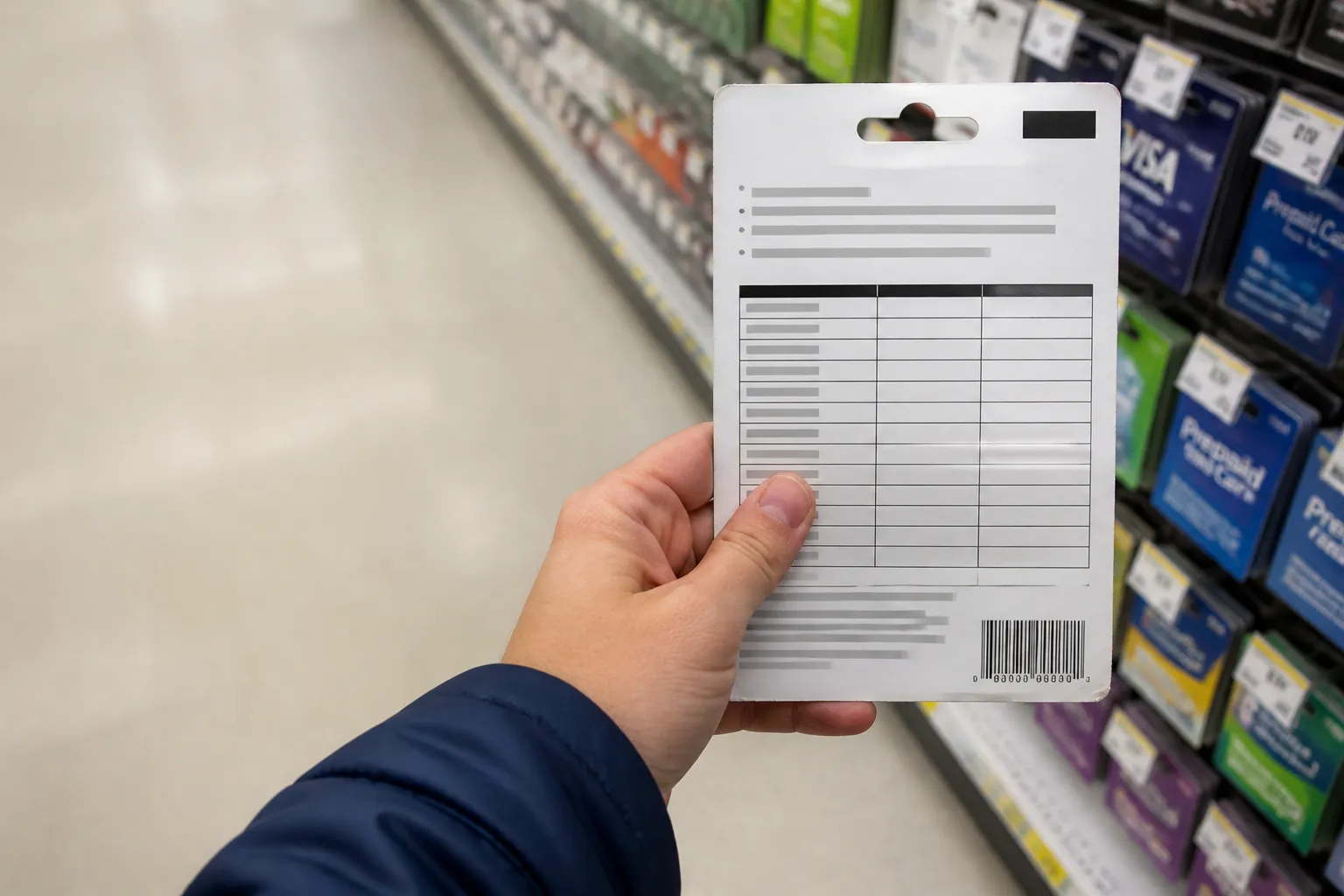
Federal rules require card issuers to display a standardized fee schedule directly on retail packaging, giving shoppers a way to compare ongoing account costs before purchase.
What to check before you buy
Prepaid card providers must give you fee and term disclosures before you complete a purchase or select a card. Under rules established by the Consumer Financial Protection Bureau, retail packaging includes a standardized prepaid fee disclosure chart. This chart lets you evaluate initial and ongoing costs side by side in the store aisle. The disclosure reveals the highest amount a provider can charge for regular services, which gives you a clear baseline for comparing competing products.
Beyond the pricing chart, examine the administrative features outlined in the agreement. You should confirm whether the card allows registration, whether the provider delivers regular account history statements, and whether the card includes liability and error resolution protections. You should also verify if the company maintains an accessible website with comprehensive cardholder terms. If a card issuer does not offer clear account history tracking or formalized dispute paths, resolving mistaken charges or billing errors later becomes significantly more difficult, as noted in the CFPB guidance on retail prepaid purchases.
Pay close attention to what you pay on day one. When you purchase a prepaid card at a merchant, your total checkout cost consists of two distinct components: the initial load balance, which is the cash deposited onto the card for spending, and the price of the card itself. Certain cards enforce a mandatory minimum load amount at purchase. If a card requires a forty-dollar minimum deposit and carries a separate purchase charge, your out-of-pocket register expense will be higher than the balance you planned to allocate for the week.
Protecting your money
The safety of your funds rests heavily on steps you take immediately after checkout. Registering your card and confirming that the issuing company verifies your identity provides a primary layer of security. If an unregistered card is lost, dropped in a parking lot, or stolen from a wallet, the funds are often treated like lost cash. Registered cards, by contrast, link the balance to your verified personal profile, allowing the issuer to assist if unauthorized transactions occur.
Federal protections ensure that you can get your money back if your registered card or funds are lost or stolen, depending on the card's specific dispute rules. Furthermore, federal rules govern how employers disburse earnings: your employer cannot force you to accept wages exclusively on a payroll card, according to the CFPB prepaid accounts overview. You have the right to request payment through other established channels, such as direct deposit into an existing account.
It is important to note that published regulatory summaries do not detail the exact operational steps for every card provider. The specific procedures for locking a lost card, lodging an unauthorized charge notice, or filing a formal dispute vary across issuers. Review the printed cardholder agreement inside the package and locate the customer service contact channels on the provider's official website before you start using the card for primary expenses.
Understanding the fees
Prepaid cards assess fees across several operational categories. While the published rules do not cite specific dollar limits or typical averages for the market, the disclosures categorize the common charges you will encounter:
- Activation or purchase fee: This can be a flat amount or calculated as a percentage of the initial cash load. At a retail counter, this fee often appears as the listed purchase price of the card package itself.
- Monthly maintenance fee: A fixed sum deducted automatically from your card balance each month, even if you execute zero transactions. Some cards offer waivers if you enroll in direct deposit or maintain a specific monthly deposit volume.
- Per-purchase transaction fee: A charge deducted each time you swipe or enter the card number at checkout. Certain cards apply this fee only to signature purchases, PIN-debit entries, or online orders.
- ATM withdrawal and inquiry fees: Cash withdrawals are typically free or offered at a reduced rate at machines inside the provider's designated network. Using an out-of-network ATM routinely triggers a fee from the card issuer alongside whatever surcharge the machine operator imposes. Balance inquiries at an ATM can also incur an automated fee.
- Cash reload fee: A transaction surcharge assessed by retail partner networks each time you hand cash to a cashier to top off the card balance.
Because providers sometimes label these costs using distinct terminology, read through the complete schedule detailed in the CFPB summary of prepaid card fee types. Checking your remaining funds through the provider's official mobile portal or automated phone system is frequently free, whereas conducting the same inquiry at an automated teller machine can slowly erode your balance.
Choosing a fee structure that fits your use
Selecting the most economical card depends entirely on how many times you plan to use it each month. A card carrying a fixed monthly service fee may seem expensive at first glance, but it frequently includes unlimited free purchase transactions. For households running ten, twenty, or thirty small transactions each month for gas, groceries, and pharmacy stops, a predictable monthly fee structure usually results in lower cumulative costs than paying a transactional fee on every swipe.
Conversely, a card advertised with no monthly maintenance fee often operates on a pay-as-you-go model. In these arrangements, the issuer charges a small fee every single time you buy an item. If you make purchases several times a week, those small transaction deductions add up quickly and can easily exceed the cost of a flat monthly rate. As outlined in the CFPB guidance on avoiding monthly fees, some providers let you select between a monthly plan and a per-transaction plan, allowing you to switch plans based on your spending volume.
Before committing to a card, ask whether the monthly charge can be completely avoided. Many issuers waive the monthly account fee if you receive recurring payroll or government benefit deposits, load a required minimum dollar amount over the billing cycle, or complete a minimum number of purchases. Review the written agreement to confirm the exact qualifying criteria, as waiver thresholds differ between card products.
Deposit insurance and gaps in the record
Many consumers assume that loading money onto a commercial payment card provides the exact same safeguards as holding cash in a traditional checking account. However, public regulatory materials from the Federal Deposit Insurance Corporation, such as general resources on prepaid cards and deposit insurance coverage, do not uniformly confirm that every retail prepaid product carries pass-through insurance protection. Never assume your funds are insured against institution failure without reading the formal disclosure document and confirming the deposit structure with the issuing bank.
Standard regulatory overviews also leave out specific mechanical instructions for day-to-day card management. Agency publications highlight that adding funds, tracking daily ledger balances, and replacing an expired card are common consumer concerns, yet they do not establish universal steps across all brands. You must consult the specific cardholder contract and the issuer's website to understand how replacement cards are issued, what happens to unspent funds when a card plastic expires, and what options exist for recovering your cash balance if you close the account.
Please seek a professional. This article is general information, not financial, tax or insurance advice. Please seek a licensed financial, tax or insurance professional about your own situation.


