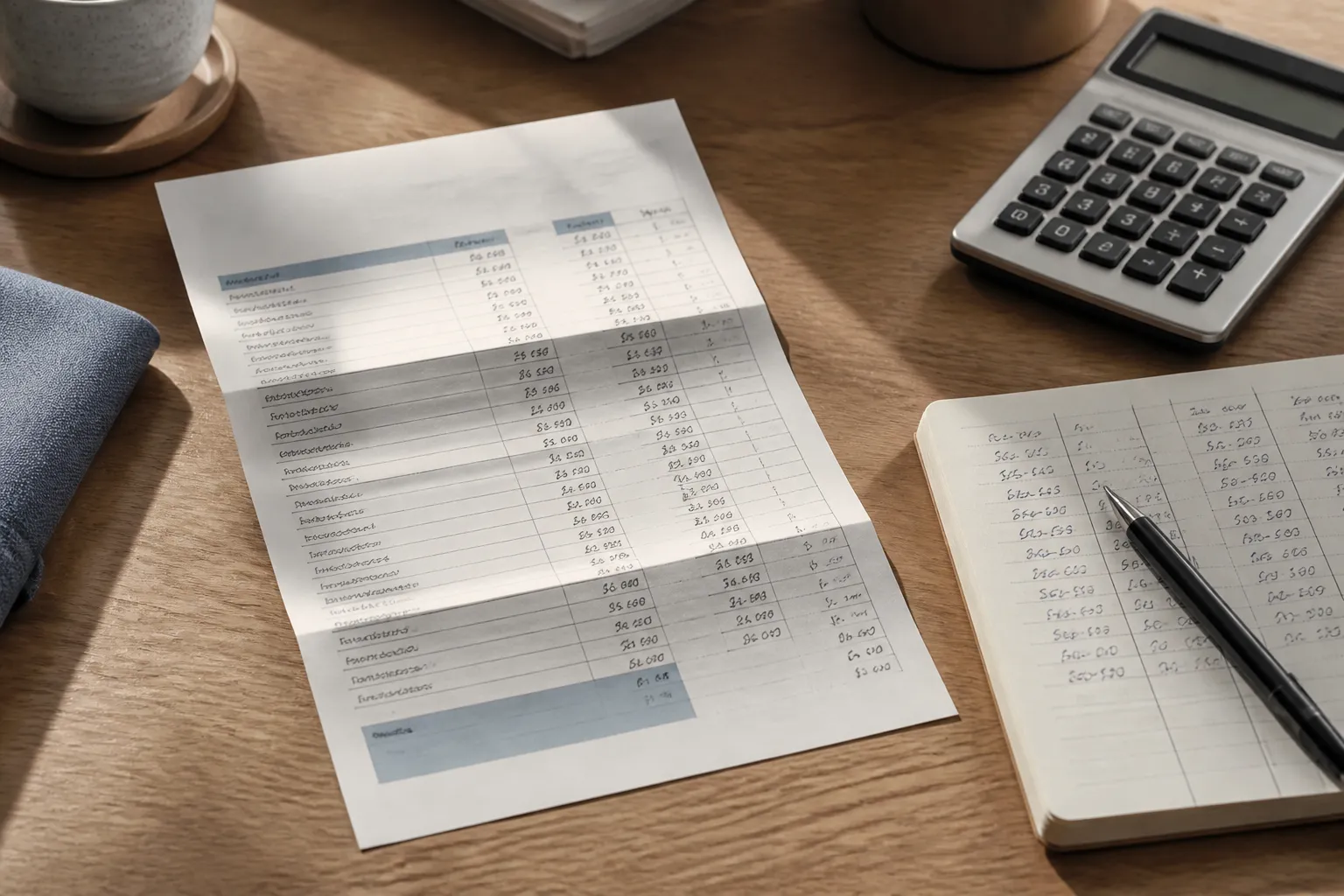











A utility bill can go up even when the meter shows nearly the same usage as last month. To find out why, read the charges in groups rather than starting with the total due. Which amount stays fixed? Which one changes with usage? Which line reflects the cost of electricity or gas? And which charges have their own approval or adjustment schedule?

Start with four kinds of charges
Many bills contain a customer charge, a rate for delivering service, a supply cost, and one or more riders. The customer charge is generally a fixed amount for maintaining an account. Delivery rates often depend on how much service you use. For electricity, usage is measured in kilowatt-hours, or kWh. The supply charge reflects the cost of the electricity or gas itself.
Those parts do not move together. A fixed charge can stay the same while a usage-based charge rises. Supply costs can change with fuel prices and market conditions even if household usage barely changes. Washington’s utilities commission describes the main bill components and explains that utilities must file requests with the commission to change what they are allowed to charge. The details of an approved rate or adjustment depend on the utility and its state rules. A bill alone may show the new amount without explaining the filing behind it. Washington’s bill guide is one example of how a regulator separates these charges.
Read a rider as a separate claim
A rider, sometimes called a surcharge or adjustment, recovers a particular cost outside the standard base rate. Its name may point to fuel costs, storm repairs, energy-efficiency programs, or infrastructure work. The label is a starting point, not a full explanation. A line called an adjustment may not tell you what expense it covers or how its amount was calculated.
Base rates can remain in place for years, while some riders change on a shorter schedule under an approved formula or cost-recovery plan. That helps explain a bill with an unchanged base rate but a higher rider. In some states, riders are reviewed and reconciled against actual costs, and over-collection can result in a customer credit. That possibility does not establish that every rider on every bill carries the same review schedule or credit rule.
For a rider that has changed, the useful questions are precise: What cost does it recover? What period does it cover? When was it last adjusted or reviewed? Is there an approved collection limit? The utility’s tariff or bill explanation and the state commission’s public filings may answer questions the short label on the bill leaves open. This explanation of riders and surcharges gives examples of the names that may appear.
Use averages carefully
A breakdown of a typical bill can show why usage is only part of the story. In an American Gas Association description of the average U.S. residential natural gas bill, the gas itself accounts for less than 27 cents of each dollar. About 49 cents goes toward delivery, including pipes, meters, safety work, maintenance, and customer service. The association describes roughly 16 cents of that delivery share as fixed and 33 cents as variable.
It also puts taxes at about 9 cents per dollar and policy riders and surcharges at about 10 cents. These are national averages, not a template for checking a particular household’s arithmetic. Your bill may use different labels, reflect different approved charges, or cover more than one service. The useful comparison is between the parts of your own bills: did the supply price change, did a rider grow, or did more usage drive the increase?
Compare the line, the rate, and the usage
Put two bills side by side and first check that they cover comparable billing periods. Then compare the meter readings or usage totals. A higher total paired with higher kWh use may have a different explanation from a higher total with nearly unchanged kWh use. Next, compare the per-unit rates and each rider amount. A charge may rise because its rate changed, because it applies to more units, or both.
Check taxes and fees separately. Some appear as a percentage of other charges, so their dollar amount can rise even if the percentage stays the same. If the bill includes an alternative energy supplier, identify its supply charge separately from the utility’s delivery charges. Supplier charges may appear on the utility bill or on another bill. The Ohio Consumers’ Counsel’s bill guide recommends checking bills regularly for unusual charges and tracking normal usage.
If a changed line remains unclear, note its exact name, the two amounts, the billing dates, and the usage figures before asking for an explanation. Those details make the question more useful than asking only why the total went up.
Know what the bill cannot confirm
A bill can show that a surcharge appeared or grew. It usually cannot, by itself, confirm the approved cap, the date of the latest review, or whether a later reconciliation will produce a credit. Those answers may be in the utility’s tariff, a filing, or a state commission record. Rules and terminology vary by state and utility.
A large increase with little change in usage deserves an explanation, but it does not by itself prove an error. Ask whether the change came from a base rate, a supply price, a rider, a tax, or an estimated meter reading. If paying the bill is difficult, the utility or state may also have information about assistance programs. Keep the question tied to the charge shown: what changed, when did it take effect, and where is the approved rate or adjustment recorded?
Please seek a professional. This article is general information, not financial, tax or insurance advice. Please seek a licensed financial, tax or insurance professional about your own situation.