
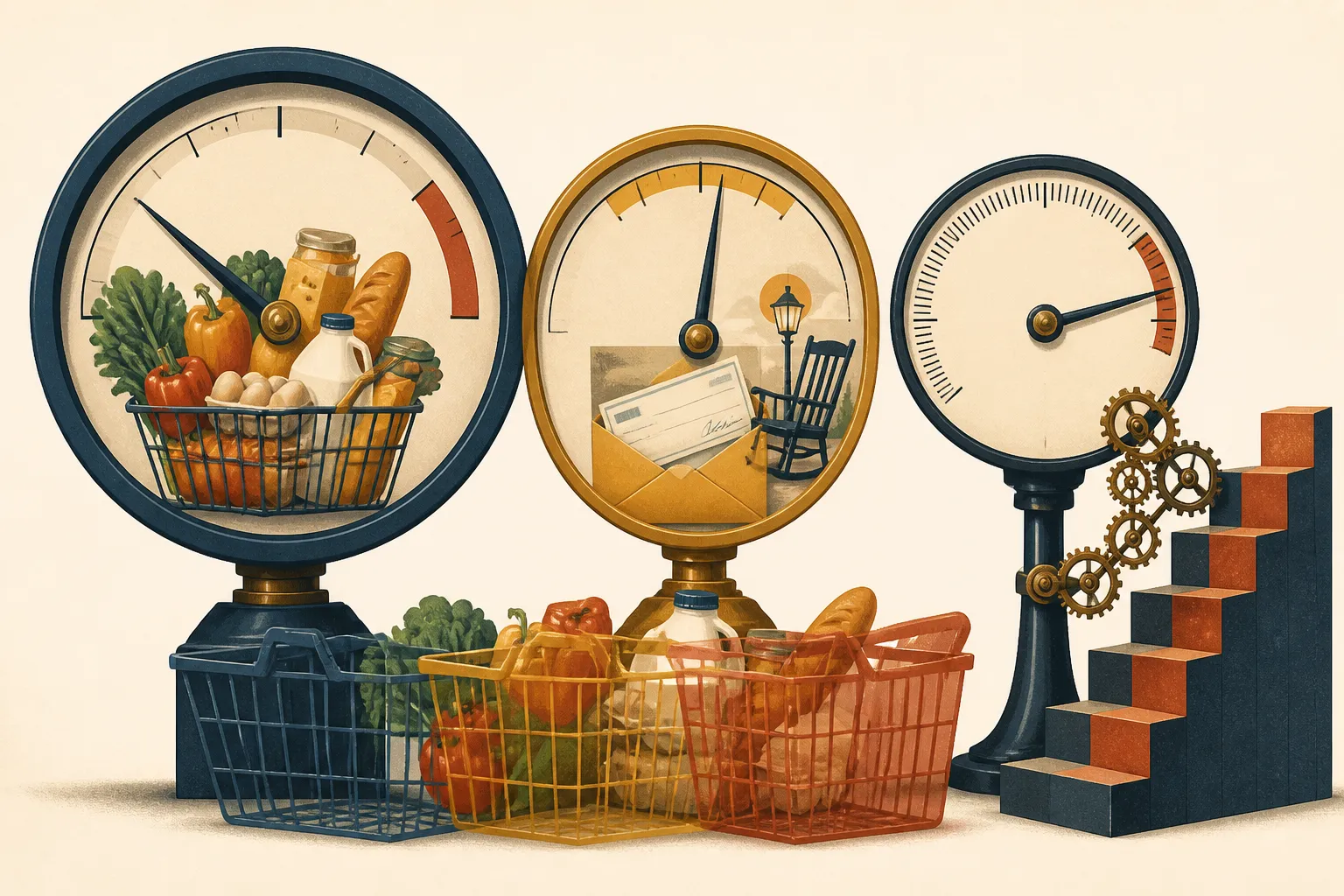
When the federal government reports that prices rose last month, households hear a single headline number. Behind that headline sit several distinct price gauges maintained by the U.S. Bureau of Labor Statistics (BLS), and each one does a different legal job. One governs the annual boost to Social Security checks. Another sets the pace for federal income tax brackets. A third drives the morning news. Knowing which initials apply to your kitchen-table math starts with looking at how the government splits up the shopping cart.
- CPI-U (Consumer Price Index for All Urban Consumers): The broad headline gauge that the BLS monthly news release leads with to describe general inflation.
- CPI-W (Consumer Price Index for Urban Wage Earners and Clerical Workers): The narrower index used to calculate annual cost-of-living adjustments (COLAs) for Social Security and federal retirement benefits.

- C-CPI-U (Chained Consumer Price Index for All Urban Consumers): A slower-growing measure that accounts for shoppers swapping out expensive items, used since the 2017 tax reform law to adjust federal tax brackets and standard deductions.
What the CPI-W and CPI-U measure
The BLS publishes both the CPI-U and the CPI-W, which is why official reports and policy guides treat them as separate tracks rather than interchangeable numbers. The CPI-U covers all urban consumers. Because it casts a wider net, it serves as the primary number in the monthly inflation summary.
The CPI-W tracks a more specific group: urban wage earners and clerical workers. Despite being narrower, the CPI-W carries direct weight for retirees and beneficiaries because federal rules tie the current Social Security and federal retirement COLA directly to it.
Basic agency summaries do not always lay out the exact population weights or item-by-item differences between the two indexes. Before assuming one rises faster than the other in a given month, check the detailed BLS CPI questions and answers to see how the agency defines each group.
How the chained CPI fits in
A third measure, the Chained Consumer Price Index for All Urban Consumers (C-CPI-U), looks at the grocery basket differently. Traditional indexes track the price of a fixed set of goods. The chained CPI tracks both prices and the quantities people actually buy.
If the price of beef jumps and shoppers buy chicken instead, the chained CPI counts that switch as a substitution effect. Because it assumes households trade down when specific items get pricey, the chained CPI generally grows more slowly than traditional CPI measures.
That slower pace has real consequences when Congress writes it into law. Under the 2017 tax reform law, federal tax provisions including marginal tax rates, tax credits, and standard deductions were indexed to inflation using the chained CPI-U. According to a policy overview from the Harris Federal Law Firm, that law marked the first time the federal government used the chained index for tax thresholds. Because thresholds rise more slowly under a chained measure, more of a household's income can creep into higher tax brackets over time. The 2017 tax law did not change how the annual retirement COLA is calculated, though lawmakers periodically debate whether to apply chained CPI to benefit formulas in the future.
Choosing the right index for a rule
If you are trying to figure out how inflation will change a check or a tax bill, the only reliable method is to read the underlying rule and see which index it names. General news coverage will almost always quote the CPI-U, while tax forms reflect the C-CPI-U and retirement adjustments follow the CPI-W.
Timing rules matter just as much as the initials. For a Social Security or federal retirement COLA to take effect in the upcoming year, the average CPI-W for the third calendar quarter must be higher than the highest previous third-quarter average. Even if prices feel high in the spring, the third-quarter window is what locks in the adjustment.
When reviewing a contract, benefit guide, or tax change, ask two basic questions:
- Which specific BLS index does the statute or agreement name?
- Does that index actually track the spending habits of the group affected by the rule, such as wage earners versus older Americans?
If you only want a rough comparison of how buying power has shifted over the years, the agency lists a CPI Inflation Calculator on its uses of the CPI page, though you will need to visit the tool directly to see which index series it pulls from.
Source reliability and gaps
Commentary around inflation adjustments often blurs these three measures together, and that creates confusion. Any secondary article that treats the chained CPI as a direct stand-in for the CPI-W risks misstating how retirement benefits change. When reading policy estimates, look closely at where the numbers come from. For instance, the Harris Federal article cites an executive summary estimating that switching to a chained CPI would save the federal government roughly $150 billion over 10 years. Treat figures from private law firms and advocacy groups as specific projections, and verify the underlying mechanics against official government publications.
Keep in mind what general index explainers leave out. Standard backgrounders do not list current monthly index values or the latest COLA percentage, and some federal reference pages, such as the Office of Personnel Management COLA FAQ, may require navigating through portal menus to find the active calculation tables. Finally, no national price index can tell you how to set your personal household budget, savings rate, or borrowing plans. Use the federal numbers to understand the rules governing your taxes and benefits, then rely on your own receipts to manage your cash flow.